PU Grouting for Industrial Structural Repair
Retrofitting services help improve the performance of existing industrial, commercial, and infrastructure structures without automatically replacing the entire asset. As concrete structures age, changes in loading, deterioration, corrosion, cracking, leakage, or operational requirements can create the need for strengthening and rehabilitation. PU grouting and injection grouting may form part of this wider repair strategy when water ingress, cracks, voids, or construction joints require targeted treatment based on actual site conditions.
Why Existing Structures Require Retrofitting
The decision to retrofit should begin with understanding why a structure has become vulnerable. Visible cracks, damp patches, honeycombing, exposed reinforcement, settlement, leakage, or repeated repair failures can indicate deeper problems. A proper assessment helps distinguish between surface defects and issues affecting structural performance. This distinction matters because grouting is not a universal solution, while strengthening methods must be selected according to the type, location, severity, and cause of deterioration.
Role of Retrofitting in Structural Rehabilitation
Retrofitting services can involve several engineering techniques, including structural strengthening, concrete rehabilitation, jacketing, fibre reinforcement, crack repair, corrosion treatment, and specialised grouting. The objective is to restore or improve the required performance of an existing asset while limiting unnecessary disruption. For industrial facilities, the approach may also consider production schedules, access limitations, safety requirements, and surrounding equipment. A planned methodology therefore becomes as important as the repair material itself.
What Is PU Grouting?
PU grouting is commonly considered when water leakage needs to be controlled through cracks, joints, voids, or other pathways within suitable concrete structures. Polyurethane grout can react with moisture and expand, allowing it to occupy leakage paths and create a seal. Its application requires suitable material selection, injection control, and site preparation. The treatment should focus on the actual water path rather than simply covering the visible damp area from the surface.
PU Injection Grouting for Water Leakage
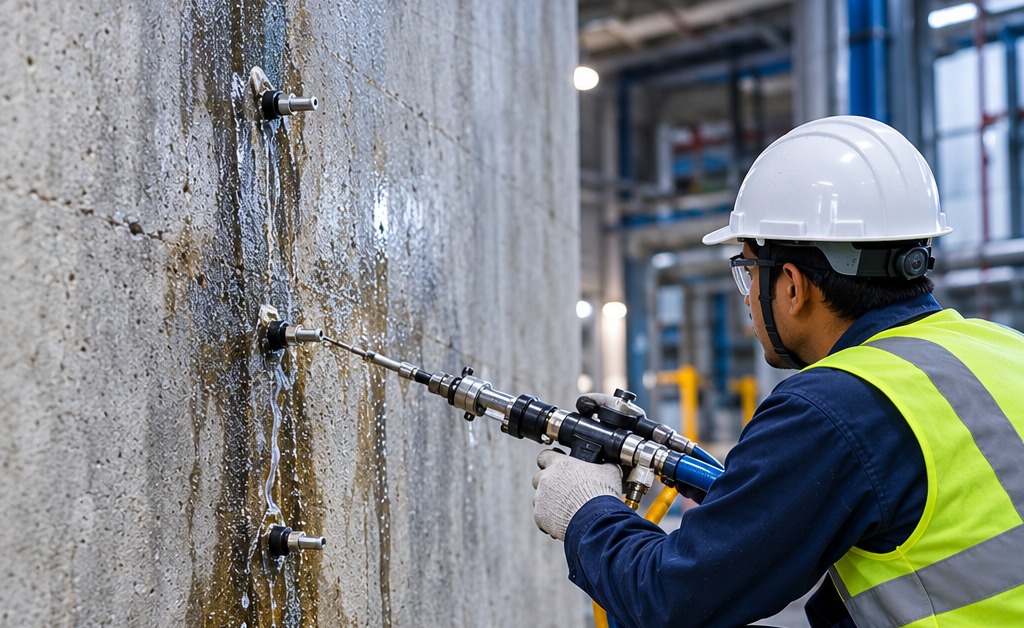
PU injection grouting is different from simply applying a waterproof coating over a leaking surface. Injection directs grout into identified cracks, joints, cavities, or internal leakage routes through installed injection ports. Depending on the product and application, the material may expand and form a flexible sealing system. This makes the technique useful for certain active leakage conditions where water is travelling through concrete and conventional surface treatment may not address the internal pathway.
Where PU Injection Grouting Is Used
Industrial structures often experience water ingress through construction joints, cracks, basement walls, slabs, retaining elements, underground areas, and service penetrations. Persistent moisture can contribute to staining, corrosion, concrete deterioration, equipment-area damage, and maintenance problems. PU injection grouting can be considered where the leakage mechanism is suitable for chemical injection. However, the source of water, movement of the crack, concrete condition, and surrounding details should be evaluated before selecting the treatment.
Difference Between PU Grouting and Other Injection Grouting
Injection grouting is a broader repair approach that can use different grout materials for different engineering purposes. PU grout is generally associated with leakage sealing, while epoxy or cement-based grouts may be selected for other crack filling, void filling, bonding, or rehabilitation requirements. Choosing the material only because a particular product is popular can lead to unsuitable results. The grout should instead match the crack characteristics, moisture condition, structural requirement, and intended outcome.
Choosing Injection Grouting Contractors
Injection grouting contractors play an important role because the quality of the repair depends on more than the chemical used. Correct drilling, packer placement, surface preparation, injection pressure, material handling, and sequencing influence the outcome. Experienced contractors also need to recognise when leakage is caused by joints, drainage problems, movement, or external water pressure. A technically planned process reduces the risk of treating symptoms while leaving the underlying pathway unresolved.
Site Assessment Before PU Injection Grouting
Before PU injection grouting begins, the affected area should be inspected and documented. Contractors may identify crack locations, leakage intensity, joint conditions, concrete defects, and accessible injection points. Photographs, drawings, and site observations can help define the treatment zone. Where necessary, the repair team may also review available structural information. This preparation helps determine whether injection grouting is appropriate and supports a clear execution plan for the affected industrial or commercial asset.
How PU Injection Grouting Works
The injection process generally starts with preparing the concrete surface and establishing suitable injection points along the identified leakage route. Packers or injection ports are installed at planned locations, followed by controlled grout injection using appropriate equipment. Pressure and material consumption need monitoring throughout the operation. The objective is to achieve adequate penetration and sealing without creating unnecessary stress in the surrounding concrete. After curing, excess material can be removed and the surface restored.
Importance of Controlled Injection Pressure
Injection pressure is an important consideration during grouting because excessive pressure can create additional cracking or disturb weak concrete. The correct pressure depends on the structure, crack geometry, grout properties, and site condition. Contractors should therefore avoid treating pressure as a fixed number for every project. Controlled injection, observation of grout movement, and monitoring of adjacent points help the team understand how the material is travelling through the affected area during execution.
PU Grouting for Industrial and Infrastructure Structures
PU grouting can be particularly useful for water leakage repair in areas where conventional access is difficult. Industrial basements, underground structures, water-retaining elements, tunnels, concrete joints, and other infrastructure components may contain internal leakage paths that are not easily reached by surface methods. Injection provides a way to treat selected internal pathways from accessible points. The suitability of the method still depends on the structure, leakage behaviour, material compatibility, and required service performance.
Combining Retrofitting and Grouting
Retrofitting and grouting may also work together on ageing concrete structures. For example, an asset may require structural strengthening because of increased loading while separately needing injection grouting to control water ingress through cracks or joints. These issues should not automatically be treated as one problem. Structural capacity and waterproofing performance involve different considerations. A coordinated repair plan can sequence the works properly and prevent one treatment from interfering with another or hiding unresolved defects.
Why Diagnosis Matters Before Repair
One common mistake is choosing a repair method based only on the visible defect. A leaking crack may appear small while extending deeper into the concrete, and a damp surface may originate from a distant pathway. Similarly, a cracked structural member may require strengthening rather than sealing alone. Engineering assessment helps identify the mechanism behind the defect. This is why professional retrofitting services usually begin with diagnosis before recommending specific repair materials or techniques.
Factors Affecting Injection Grouting Cost
The cost of injection grouting depends on several project conditions rather than simply the quantity of grout used. Crack length, leakage severity, access, drilling requirements, number of injection points, grout type, equipment, working height, safety arrangements, and surface preparation can influence the overall scope. Industrial projects may also require shutdown coordination or restricted working hours. A site inspection and clearly defined treatment area provide a better basis for comparing quotations from injection grouting contractors.
Selecting the Right Injection Grouting Contractors
Selecting injection grouting contractors for an industrial project requires attention to technical capability and execution planning. Review the contractor’s experience with similar concrete conditions, ability to inspect leakage pathways, available injection equipment, material knowledge, safety practices, and documentation process. It is also useful to understand whether the contractor can coordinate grouting with structural repair and waterproofing activities. The lowest quotation may not represent the most suitable solution if the proposed methodology does not address the actual defect.
Retrofitting for Industrial Project Requirements
For industrial and infrastructure assets, repair work often needs to happen without unnecessary disruption to operations. Retrofitting services should therefore consider access routes, equipment protection, work permits, shutdown windows, worker safety, and material storage before execution. Injection grouting may require temporary arrangements around the affected zone. A well-planned method statement can help coordinate these requirements and reduce avoidable delays while maintaining control over the repair sequence and site conditions.
Quality Control During Grouting Work
Quality control during PU injection grouting includes checking the prepared surface, injection points, material quantities, equipment condition, and progress of the treatment. The team should document important stages and observe how grout travels through the affected area. After completion, the treated location should be inspected for remaining leakage or visible defects. If water continues to enter, the cause should be investigated rather than repeatedly applying surface sealants over the same unresolved pathway.
Maintenance After PU Injection Grouting
Maintenance after grouting is important because successful leakage control does not remove every possible cause of future deterioration. Facility teams should monitor previously repaired locations for renewed dampness, crack changes, staining, corrosion, or concrete damage. Nearby joints, drainage systems, waterproofing details, and service penetrations may also require periodic inspection. Maintaining records of repair locations and observed conditions helps identify recurring problems and supports better decisions when future structural rehabilitation or retrofitting becomes necessary.
Integrated Approach to Structural Repair
A complete repair strategy should connect assessment, structural requirements, leakage control, material selection, and execution planning. Integrated Leakage Rehabilitation Planning can help project teams look beyond isolated symptoms and consider how water ingress, concrete deterioration, joints, drainage, and structural performance interact. This approach is especially useful for industrial assets where repeated maintenance can interrupt operations. A coordinated methodology can also help determine whether grouting should be followed by additional concrete repair or strengthening.
Choosing a Suitable Engineering Partner
When choosing a company for this type of work, project owners should look for a contractor that can connect assessment, repair methodology, material selection, and execution rather than offering a single treatment for every defect. Gubbi Civil Engineers Limited can be considered for industrial, commercial, and infrastructure requirements involving structural repair, retrofitting, and grouting. The recommended solution should still be based on site assessment, leakage conditions, structural requirements, and the intended performance of the asset.
Temporary Leakage Control vs Long-Term Rehabilitation
A practical repair strategy should also distinguish between temporary leakage arrest and long-term rehabilitation. In some situations, a rapid PU injection may be required to control active water flow before further repair work can proceed. Additional treatment may then be needed to address concrete deterioration, corrosion, joints, drainage, or structural strengthening. Understanding this sequence prevents project teams from expecting one injection operation to solve every defect affecting an ageing structure.
Retrofitting services, PU grouting, PU injection grouting, and injection grouting contractors each address different parts of the structural repair process. The right solution depends on what the assessment reveals, whether the primary concern is strength, leakage, voids, cracking, deterioration, or a combination of conditions. For industrial and infrastructure assets, selecting the method based on engineering requirements can improve repair planning, reduce unnecessary work, and support continued serviceability of existing structures. For project owners dealing with concrete leakage, structural deterioration, or ageing assets, the next step should be a proper inspection rather than immediately selecting a repair product. Identify the affected locations, document visible defects, understand operational constraints, and obtain a technically defined treatment proposal. When the scope is clear, retrofitting and grouting works can be planned with appropriate materials, equipment, safety controls, and quality checks, giving the existing structure a more considered path toward rehabilitation.
Comments
Loading comments...